Shakespeare and Time
the retrieved pasts,
the envisaged futures
Edifício Abel Salazar, Universidade do Porto
Organised and hosted by
Faculty of Arts and Humanities, University of Porto
CETAPS – Centre for English, Translation and Anglo-Portuguese Studies
ESRA 2025 will explore temporality from a variety of angles. Stimulated by Aleida Assman’s description of the “time regime of sustainability”, in which the future “is no longer the opposite of the past but intimately linked to something in the past, which is to be ensured for the future”, this conference will be devoted to discussing that which, though it may please some, tries all, as its personification in The Winter’s Tale announces a little after the middle of the play. Its power “To o’erthrow law”, as well as “To plant and o’erwhelm custom”, makes us ask questions about temporality in Shakespeare: the different times and velocities of the plays and poems, either precisely delineated or vaguely hinted at; the roles, shapes, and valences of the past, between rehearsals of lineage and revivals of Antiquity; time viewed through history and competing historiographies (from chronicle, political history, and antiquarianism to dramatic or poetic histories); time as bringer of ruinous or welcome change, through contingency or necessity, to be resisted in tombs of brass or poetic monuments; and the shaping and political uses also of the future, from prophecy to utopian / dystopian scenarios.
Because this conference is as much about Shakespeare’s Europe as it is about Europe’s Shakespeare(s), it is equally interested in the temporality of afterlives, manifold receptions, and preposterous temporal inversions. Considering the historical engagement with these complex and superimposed temporalities, ESRA 2025 invites investigation into the politics of time, forms of nostalgia and of the regressive imagination, cultures of memory and commemoration, the competing or concerted pulls of historicist and presentist approaches, among other ways of thinking about queer temporalities, natural and human time, anachronism, and even atemporality.
Important Dates
Confirmed Guest Speakers




Michael Dobson is Director of the Shakespeare Institute in Stratford-upon-Avon: previous employers include Oxford, Harvard, and the University of London. He is co-director of the Shakespeare Centre, China, at Nanjing University, a trustee of the Shakespeare Birthplace Trust, an honorary governor of the Royal Shakespeare Company, and secretary of Britain’s All Party Parliamentary Group on Shakespeare. He is also an honorary member of the Academy of Sciences of the Higher School of Ukraine, and holds honorary degrees from Lund and from Craiova. His publications include: The Making of the National Poet; England’s Elizabeth (with Nicola Watson); The Oxford Companion to Shakespeare (with Stanley Wells); Performing Shakespeare’s Tragedies Today; and Shakespeare and Amateur Performance.
Evelyn Gajowski is Professor of English Emerita and Barrick Distinguished Scholar at the University of Nevada, Las Vegas. She has written or edited five books on Shakespeare, including The Arden Research Handbook of Contemporary Shakespeare Criticism (Bloomsbury 2021); The Merry Wives of Windsor: New Critical Essays, with Phyllis Rackin (Routledge 2015); and Presentism, Gender, and Sexuality in Shakespeare (Palgrave Macmillan 2009). Her edited collection of essays, Shakespeare, Presentism, and the Legacy of Hugh Grady, is forthcoming from Palgrave Macmillan. She serves as Series Editor of the Arden Shakespeare and Theory Series; her own contribution to the Series, Shakespeare and Presentist Theory, is forthcoming from Arden/Bloomsbury.
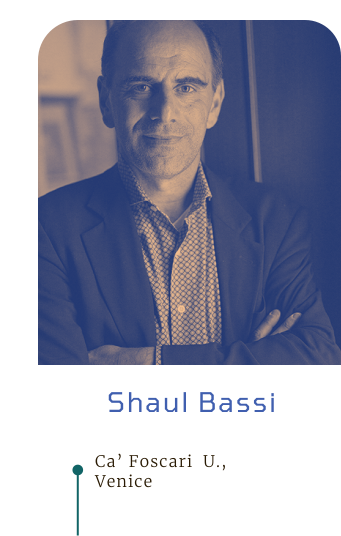
Shaul Bassi is Professor of English and Environmental Humanities at Ca’ Foscari University of Venice. His publications include Visions of Venice in Shakespeare (co-edited with Laura Tosi, Ashgate 2011), Shakespeare’s Italy and Italy’s Shakespeare. Place, ‘Race’, and Politics (Palgrave Macmillan 2016), The Merchant in Venice. Shakespeare in the Ghetto (co-edited with Carol Chillington Rutter, Edizioni Ca’ Foscari 2021), Venice and the Anthropocene. An Ecocritical Guide (co-edited, wetlands 2023) and African Venice (with Paul Kaplan, wetlands 2024). In 2016 he spearheaded the first performance of The Merchant of Venice in the Ghetto of Venice. He is the co-founder and former director of Venice international literary festival Incroci di civiltà /Crossings of Civilizations. He is currently editing the The Merchant of Venice for the Arden Fourth series.
Boika Sokolova is Adjunct Professor at the University of Notre Dame (USA) in England, and a founding member and former Board member of ESRA.
She is the author (with Alexander Shurbanov) of Painting Shakespeare Red, An East-European Perspective (University of Delaware Press, 2001) and of numerous articles on Shakespeare in Bulgaria. She has edited, with Janice Valls-Russell, Shakespeare’s Others in 21st-century European Performance, The Merchant of Venice and Othello (Arden, 2022); with Nicoleta Cinpoes, a cluster of articles on the Tempest (Shakespeare Bulletin, Volume 29, Number 3, Fall 2011); with Evgenia Pancheva, Renaissance Refractions, Essays in Honour of Alexander Shurbanov (Sofia University Press, 2001), and with Michael Hattaway and Derek Roper, Shakespeare in the New Europe (Sheffield Academic Press, 1994).
Sokolova is also the author of Shakespeare’s Romances as Interrogative Texts (Edwin Mellen Press, 1992) and The Merchant of Venice (Humanities EBooks, 2008), as well as a number of articles, which have appeared in Shakespeare journals and essay collections.
Kirilka (Katy) Stavreva is Professor and Chair of the Department of English and Creative Writing at Cornell College, USA, where she founded the Foxden Press, a historic letterpress printing operation. She is a current Board member of ESRA.
Stavreva is the author of Words Like Daggers: Violent Female Speech in Early Modern England (University of Nebraska Press, 2015) and contributing editor of two e-book series on British Literature for the Gale Researcher platform (Cengage, 2017) as well as of the essay cluster Multidisciplinary Perspectives on Teaching Dante’s Divine Comedy (Pedagogy, 2013).
Her scholarship on European Shakespeare and performance has appeared in numerous essay collections and journals, including Shakespeare Survey, Shakespeare Bulletin, Cahiers Élisabéthains, and Borrowers and Lenders.
As collaborators, Stavreva and Sokolova have co-authored the second edition of The Merchant of Venice (Shakespeare in Performance, Manchester University Press, 2023), the essay cluster Operation Shakespeare in Post-Communist Bulgaria (Toronto Slavic Quarterly, 2017), and have published widely on East European Shakespeare and performance in edited collections and in Cahiers Élisabéthains.
They proposed the topic and participated in the transnational 2022-23 Visegrad+ Strategic Grant, “Crossing Borders with Shakespeare since 1945: Central and Eastern European Roots and Routes,” resulting in the publication of “Eastern Europe/ Central Europe/Post-Communist Europe as Signifiers of Cultural-Political Geographies and Identities” (with Natália Pikli, Jana Wild), Multicultural Shakespeare, 28 (43), 2023.
They are working on an edited collection for Arden Shakespeare/Bloomsbury, titled “Shakespearean Adaptations in (Post)Communist Europe: Making a Cultural Legacy.
Organising committee
Convenors:
Rui Carvalho Homem
Fátima Vieira
Miguel Ramalhete Gomes
Nuno Ribeiro
Jorge Almeida e Pinho
Márcia Lemos